
How much should your dental practice invest in marketing, how to split it across channels, and what you need so every pound turns into patients in the chair.
Around 70% of dental marketing spend is not lost in the ads. It is lost in what happens afterwards: calls that go unanswered, treatment plans nobody follows up, and enquiries that go cold because no one manages them. A practice billing £25,000 a month and investing 7% in marketing (£1,750) could be throwing away more than £1,200 every month if it has no system that carries those enquiries through to the first appointment. Setting a dental marketing budget without understanding where the money is really leaking is like filling a bucket full of holes: it does not matter how much water you pour in. In this complete guide to dental marketing applied to budgeting, you will see how much your practice should invest by size, how to distribute that money across channels and, above all, what you need so every pound turns into real patients sitting in the chair.
What is a dental marketing budget and why "spending on ads" is not enough
A dental marketing budget is the planned allocation of financial resources a practice sets aside to attract, convert and retain patients, measured as a percentage of its revenue and judged by its return in first appointments and accepted treatment plans.
That definition matters because most practices confuse a marketing budget with ad spend. They are not the same. Paying £700 a month on Google Ads is ad spend. Having a marketing budget means knowing how much you allocate to each channel, what patient acquisition cost (the average cost of getting a new patient to actually sit in the chair) each one generates, and how the pieces connect: the ads, the SEO, the online reputation, the work of your front desk and the follow-up on treatment plans.
Without that complete view, a practice can be investing £3,000 a month and not know whether it is generating 5 new patients or 50. And worse: it can be generating 50 enquiries and converting only 5, because nobody measures what happens between the click and the booking.
How much should a dental practice invest in marketing in 2026?
The most solid benchmark in the UK is to allocate between 5% and 10% of gross monthly revenue to marketing. Practices in a maintenance phase (stable diary, low-competition area) can sit in the 3% to 5% range. Those pursuing active growth need 7% to 10%. And those opening or expanding to new locations may need between 10% and 15% during the first 12 months.
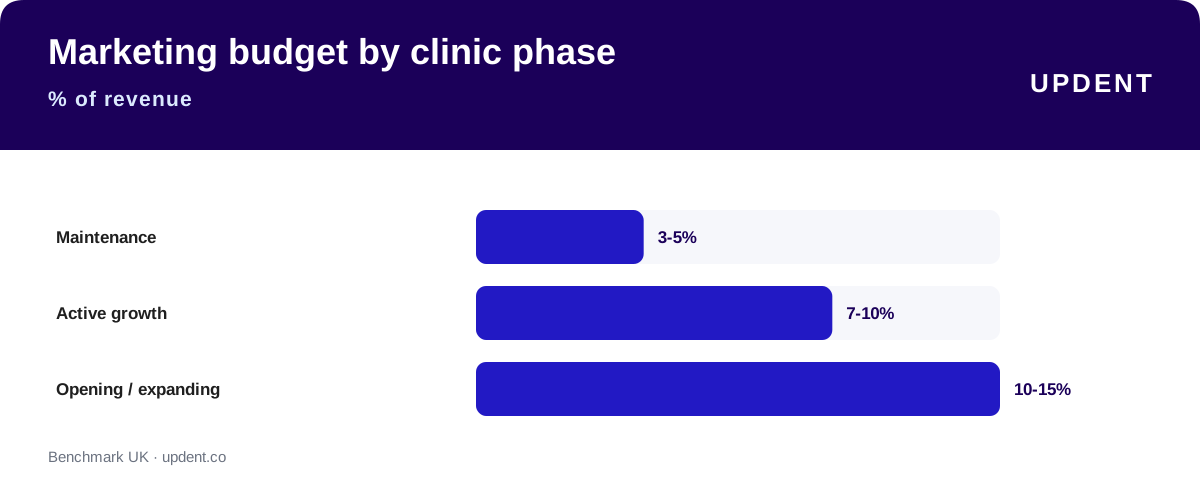
These percentages are not arbitrary. The best-performing practices are the ones that invest consistently and measure the return in real patients, not in clicks or impressions.
To put it in concrete numbers:
| Monthly revenue | 5% investment | 7% investment | 10% investment |
|---|---|---|---|
| £20,000 | £1,000 | £1,400 | £2,000 |
| £40,000 | £2,000 | £2,800 | £4,000 |
| £80,000 | £4,000 | £5,600 | £8,000 |
| £150,000 | £7,500 | £10,500 | £15,000 |
But here is a nuance that changes the whole equation: these percentages only make sense if the money is invested inside a system that measures the patient's full journey, from clicking an ad to accepting a treatment plan in the chair. If that system is not in place, the percentage is irrelevant.
The three layers of a well-distributed dental marketing budget
The distribution of the budget depends on the type of practice, its area and its goals. But the structure always follows the same order of priority, because each layer depends on the previous one.
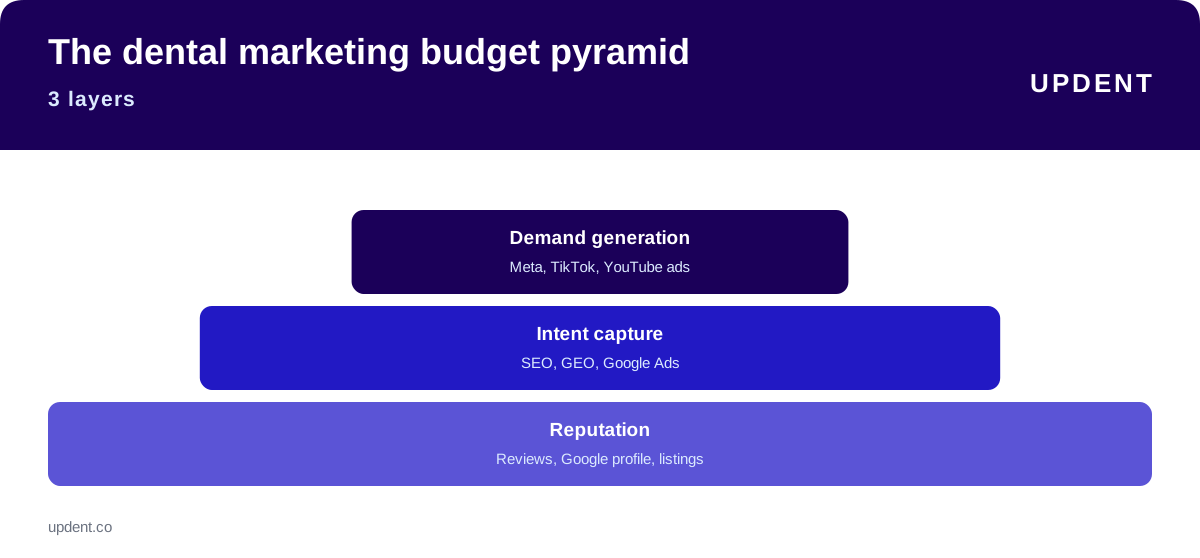
Layer 1: Reputation (the base nothing works without)
Before investing a single pound in attracting patients, your practice needs a solid reputation base. This includes a Google Business Profile optimised with professional photos, up-to-date opening hours and replies to every review. It also means an active review-generation system (review cards, post-appointment WhatsApp, automated email) and a well-maintained NHS Find a Dentist listing where relevant.
Without this layer, any investment in acquisition performs worse. A patient who finds you through Google Ads and sees that you have 12 reviews averaging 3.8 is not going to call. Your practice's online reputation is the first thing a potential patient evaluates, even before looking at your website.
Typical cost of this layer: £80 to £250/month in tools and management, plus your team's internal time. In many practices, the room for improvement here is enormous and practically free.
Layer 2: Intent capture (patients already searching)
Once reputation is in order, the next priority is to capture the people who are already actively searching for a dentist or a specific treatment. These patients have real intent: they type "dental implants London" or "invisible braces near me" into Google, or ask ChatGPT for options.
There are three intent-capture channels:
SEO (organic search ranking). It is the medium- and long-term investment that generates the lowest CPL (cost per qualified enquiry) in the dental sector: between £5 and £25 per enquiry. The catch is that it takes between 3 and 6 months to take hold. In return, it generates a steady, predictable flow of patients searching for exactly what you offer. A well-executed SEO strategy for dental practices is the most profitable marketing asset in the long run.
GEO (optimisation for AI engines). Patients increasingly search on ChatGPT, Gemini and Perplexity. Appearing in these platforms' answers is no longer optional. GEO shares much of its foundation with SEO, but it requires content with explicit definitions, verifiable data and well-marked entities.
Google Ads (search advertising). It is the channel that delivers results fastest: qualified patients from the first week. The CPL varies widely by treatment: implants between £35 and £110 per enquiry, invisible braces between £25 and £65, emergencies between £5 and £15. For well-managed dental Google Ads campaigns, the typical ROI (return on investment: what you bill relative to what you invest) sits between 3:1 and 10:1.
Layer 3: Demand generation (patients not searching yet, but who might need you)
The third layer targets people who are not looking for a dentist right now, but who fit your ideal patient profile. This is where social channels as advertising come in: Facebook Ads, Instagram Ads, TikTok Ads and YouTube.
These channels work on a different logic. They do not respond to an active search; they generate interest by showing relevant content to the right audience. They are especially effective for cosmetic treatments (veneers, whitening, smile design) and invisible braces, where the patient may not know they have a problem or that an accessible solution exists.
The CPL on Meta Ads (Facebook and Instagram) tends to sit between £15 and £55 in the UK, but the conversion rate to first appointment is usually lower than on Google Ads because the patient had no prior intent. That does not mean it does not work: it means it needs a more structured follow-up process from your front desk.
TikTok and YouTube are emerging channels in dental. They still have a low cost per impression and work well to position the practice's brand and build trust before the patient needs treatment.
How distribution varies by type of practice
Not every practice needs the same channel mix. The budget distribution changes with size, specialisation and growth goals.
Single dentist (1 chair, revenue £10,000-£20,000/month)
Indicative budget: £500 to £1,200/month.
The priority is layer 1 (reputation) and a surgical investment in intent capture. With tight budgets, concentrate 60-70% on Google Ads for the highest-margin treatments and spend the rest on maintaining local SEO and review management. Paid social as an advertising channel is not a priority at this budget: better to invest that money in turning each enquiry into a booking.
Small practice (2-3 chairs, revenue £25,000-£50,000/month)
Indicative budget: £1,500 to £3,500/month.
Here it makes sense to work all three layers. The reputation base should be covered (if it is not, it comes first). Intent capture takes the bulk: SEO, Google Ads and a patient acquisition system that includes enquiry follow-up with a marketing CRM (a system separate from your practice management software that records where each patient came from, which treatment they asked about and what happened next). Demand generation with Meta Ads can start with £200 to £500/month on cosmetic-treatment or invisible-braces campaigns.
Medium practice (4-6 chairs, revenue £60,000-£120,000/month)
Indicative budget: £3,000 to £8,000/month.
At this volume, the distribution becomes professional. SEO with a content strategy, Google Ads segmented by treatment, Meta Ads with retargeting campaigns (ads shown to people who already visited your website or engaged with your content), video content for TikTok or YouTube, and a quarterly investment in professional photography and video (£300 to £600/quarter). At this level, reactivating inactive patients by email and WhatsApp becomes the channel with the highest ROI: between 15:1 and 50:1, because it leverages trust that already exists.
Dental group or flagship practice (6+ chairs, revenue £150,000+/month)
Indicative budget: £8,000 to £20,000+/month.
The structure includes every layer at full strength: aggressive SEO with a multi-location strategy if there are several sites, Google Ads with a dedicated budget per treatment and location, Meta Ads with a full funnel (acquisition, retargeting, reactivation), YouTube and TikTok with regular content production, and a semi-in-house marketing team with specialist external support per channel. The marketing CRM is essential to attribute every first appointment to its source and calculate the real acquisition cost per treatment and per site.
What does it really cost to acquire a new patient?
The real patient acquisition cost (what it actually costs to get a patient to the first appointment, not just to fill in a form) is the metric that should govern any dental marketing budget. And it is very different from the CPL most agencies report.
The CPL (cost per lead or cost per enquiry) measures what it costs to generate a contact: a call, a form, a WhatsApp message. But a contact is not a patient. Between the contact and the first appointment there is a stretch where most of the money is lost: the front desk does not answer in time, the treatment plan is not followed up, those who did not respond are never contacted again.
To calculate it precisely:
Real acquisition cost = Total marketing investment ÷ Number of first appointments attributed to marketing
If you invest £3,000/month and generate 40 first appointments attributable to marketing, your real acquisition cost is £75 per patient. If only 12 of those 40 contacts reach the chair because your front desk did not handle the other 28 well, your real acquisition cost jumps to £250.
Those per-treatment CPLs mentioned earlier (implants £35-£110, braces £25-£65, emergencies £5-£15) are only the first half of the equation. The second half is your front-desk conversion rate: the percentage of contacts your team turns into a booked first appointment. In practices with no protocol, that rate can sit below 30%. With a well-implemented follow-up protocol, it rises to 60-70%.
The difference between those two scenarios, applied to the same marketing budget, is the difference between a profitable practice and one that says "marketing does not work".
The mistake that makes any budget insufficient
There is one mistake we see repeated in more than half of the practices that come to Updent for help: they invest in capturing contacts, but have no system to convert them into appointments.
The pattern is always the same. The practice hires an agency (or manages its own ads), contacts start coming in, but the diary does not fill at the expected pace. The usual conclusion is "we need more budget" or "this agency does not work". It almost never is.
What happens in practice: of every 100 contacts a well-run campaign generates, between 2 and 10 become patients if there is no conversion system. With a system that includes a marketing CRM identifying the source and interest of each contact, a front desk trained in follow-up protocols and a re-contact process for pending treatment plans, that figure rises to 25-40.
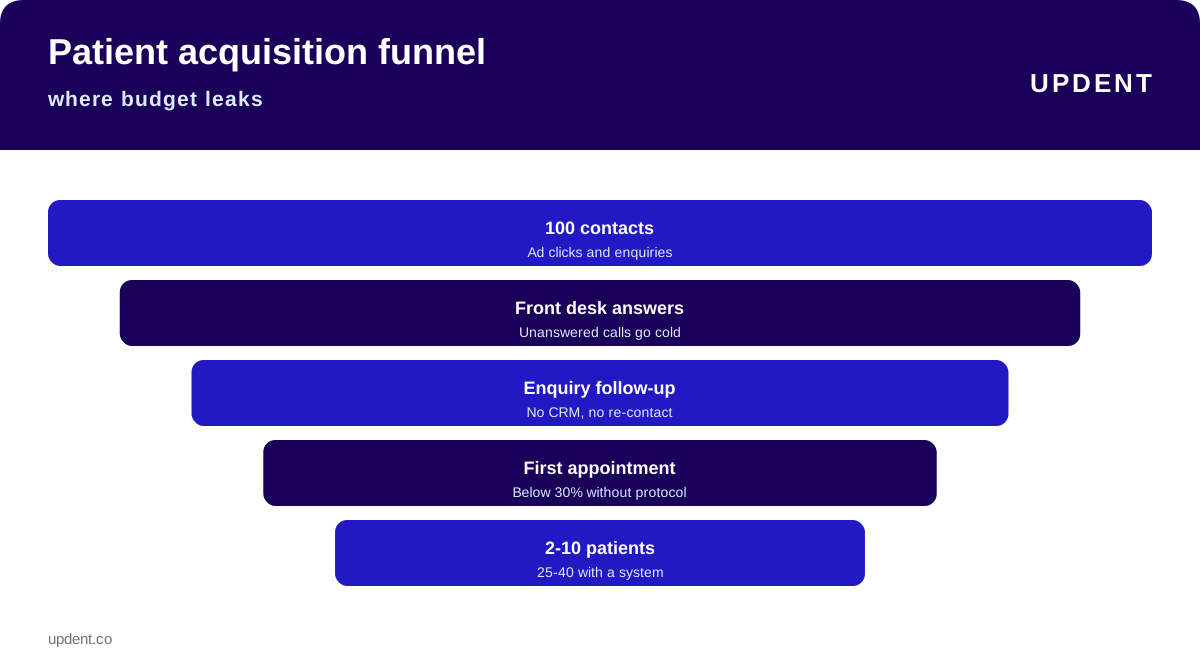
That difference is not a nuance. It is the difference between multiplying your investment or throwing it away.
That is why, before increasing the marketing budget, any practice should ask these questions: Do we answer every call within the first 30 seconds? Do we follow up treatment plans that are not accepted on the spot? Do we know which channel each patient who sits in the chair came from? Do we measure the real acquisition cost or only the leads?
If the answer to any of these is no, the first investment should not be more advertising. It should be fixing the process.
How to know whether your dental marketing investment is working
A dental marketing budget is not judged by how many contacts it generates. It is judged by how many patients reach the first appointment and how many treatment plans are accepted afterwards.
These are the metrics any practice that invests in marketing should track:
Real patient acquisition cost (by channel and by treatment). If you do not know what it costs to get an implant patient to the chair via Google Ads versus SEO versus Instagram, you cannot make budget decisions based on data.
Front-desk conversion rate. The percentage of contacts that become a first appointment. It is the metric with the greatest impact on marketing profitability and the one fewest practices measure.
First appointments attributed to marketing (by channel). Not every first appointment comes from marketing. Separating the organic ones (referral, walk-in) from those attributable to a specific action is essential to assess the return.
Treatment plan acceptance rate. If many patients arrive but few accept treatment, the problem may not be in the marketing but in how the treatment plan is presented in the practice.
ROI by channel. The return on investment of each channel: how many pounds of revenue each pound invested generates. Indicative benchmarks: SEO between 8:1 and 20:1, Google Ads between 3:1 and 10:1, reactivation email between 15:1 and 50:1, Meta Ads between 2:1 and 7:1.
What should NOT be your main metric: impressions, clicks, reach, follower count or unqualified leads. These metrics are intermediate indicators, not results. A well-structured marketing plan for your practice measures the bottom of the funnel, not the top.
Conclusion: the right budget is the one that generates profitable first appointments
There is no universal budget for every practice. What exists is a clear principle: invest between 5% and 10% of your revenue, distribute it following the order of reputation, intent capture and demand generation, and always measure the result in first appointments and accepted treatment plans, not in contacts.
If your practice already invests in marketing but you are not sure how much each new patient costs or where the contacts are lost, the first step is not to spend more. It is to diagnose where the leak is. Request your free audit and in 30 minutes we will show you where your investment is going and what you need so every pound turns into a full diary.
Request your free audit → https://updent.co/contact
Frequently Asked Questions
A dental practice with 1 to 3 chairs and revenue of between £15,000 and £50,000 a month should allocate between 5% and 10% of that revenue to marketing, which works out at between £500 and £3,500 a month. The priority should be online reputation (reviews and Google Business Profile) and intent capture with Google Ads and local SEO.

José Ramón Díaz
+10 años de experiencia en Marketing y Startups especializado en el sector Salud y Dental. Ex-DR SMILE e Impress.
Want us to implement
this in your practice?
Book your free audit and we'll show you exactly how to grow.
Talk to a Strategist