
A complete guide to dental marketing in 2026: the 10 channels that work, where clinics lose budget, how much to invest and how to measure real results.
Thousands of private dental practices across the UK compete for the same patients in an increasingly crowded market. In this context, dental marketing is no longer optional: it is what separates the clinics that fill their diary from the ones that survive on whatever patients drift in by inertia.
But there is a problem almost nobody mentions. Most clinics that invest in dental marketing measure their success in enquiries or leads. And that is exactly the wrong metric. Because 70% of dental marketing investment is lost in the journey from enquiry to first appointment: calls that go unanswered, quotes nobody follows up and enquiries that go cold because there is no clear conversion protocol.
This guide is not a generic list of channels. It is a walk through everything a dental practice needs to know in 2026 to turn its marketing spend into real patients: in the chair, with an accepted treatment plan.
What dental marketing is (and why measuring it in leads is a mistake)
Dental marketing is the set of patient acquisition, conversion and retention strategies designed specifically for dental practices. It is measured in first appointments and accepted treatment plans, not in leads or impressions.
This definition matters because it marks a fundamental difference from what most generalist agencies do. An agency working with hotels, solicitors and dentists at the same time reports enquiries generated and presents it as success. But in the dental sector, an enquiry is worth nothing if it does not end in an appointment. And the gap between the enquiry and the appointment is where most of the money is lost.
Dental marketing has characteristics that make it radically different from marketing in other sectors. The patient-clinic relationship is high involvement and low frequency: a patient chooses a dentist once and ideally keeps that relationship for 10 or 20 years. Google reviews have replaced traditional word of mouth as the main source of trust.
And there is a barrier many forget: dental anxiety affects around a third of UK adults. Dental marketing has to address that fear before asking for any action.
For all these reasons, applying generic digital marketing recipes to a dental practice does not work. You need an acquisition system that understands the full patient journey: from the moment they search "dentist near me" on Google or ask ChatGPT, to the moment they sit in the chair and accept a treatment plan.
Where dental marketing budget is really lost
The 70% of dental marketing investment that gets lost is not lost in the ads, in SEO or in social media. It is lost in unanswered calls, in quotes handed over with no follow-up, and in enquiries that go cold because reception has no clear conversion protocol.
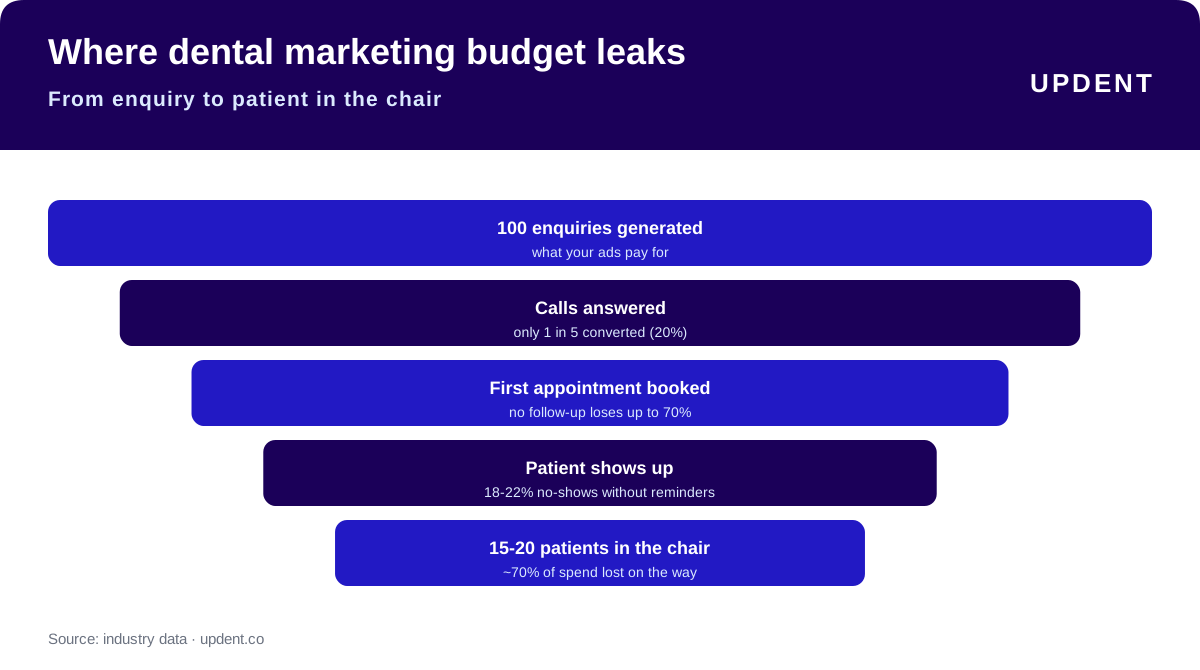
The data confirms it. Most dental practices convert only one in five phone calls they receive into patients: a 20% conversion rate. Clinics that respond in under 15 minutes double or triple that figure. And those with no follow-up system lose up to 70% of the opportunities generated by their own advertising.
The problem has three concrete causes. The first: calls are not answered in time, or are handled without specific training. The second: quotes are handed over and nobody follows up to resolve the doubts the patient never voiced in the clinic.
The third is the most invisible: there is no marketing CRM (separate from the clinical CRM) that records where each enquiry came from, which treatment they were interested in and what happened to them afterwards.
When we add the three causes together, the result is that many clinics pay to generate 100 enquiries a month and only 15 or 20 end up in the chair. The other 80 calls were lost in a black hole nobody measures because "that's not marketing". But it is. It is the most important part of dental marketing.
On top of that, no-show rates in dental practices without a management system reach 18-22%. In other words, even among those who do book an appointment, almost one in five does not turn up. With automated confirmation systems (SMS, WhatsApp), that figure drops to 5-8%.
The 10 dental marketing channels that work in 2026
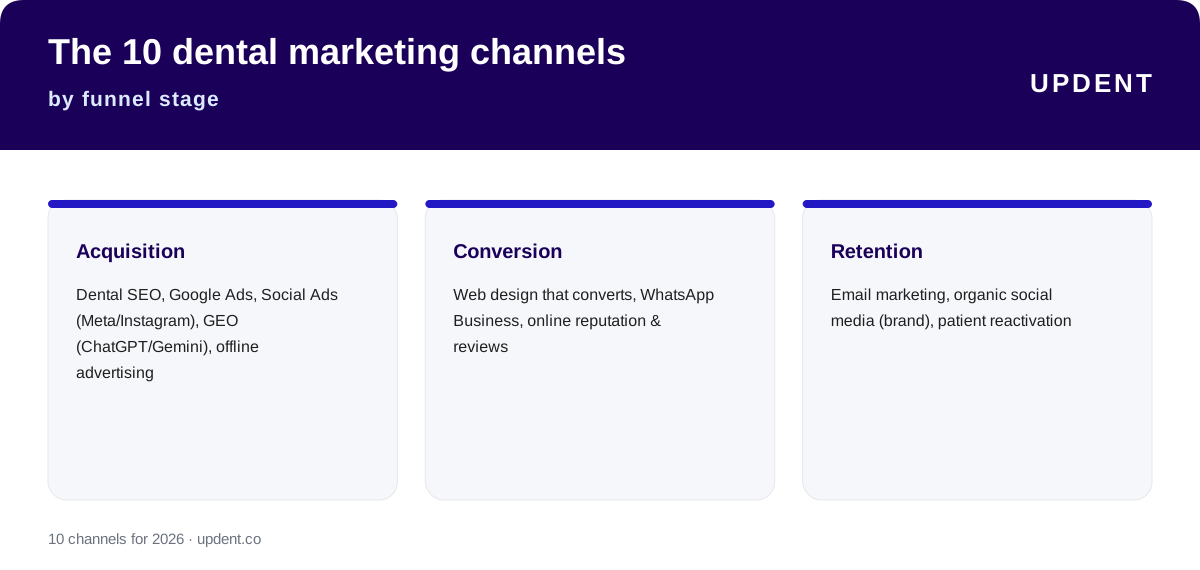
Not all channels do the same job or work over the same timeframe. The most common mistake is investing in just one and expecting it to solve everything. The clinics with the best results keep at least three channels running at once: one for immediate acquisition, one for medium-term visibility, and one for conversion and retention.
Dental SEO: organic visibility that compounds
Dental SEO is the optimisation of your clinic's website so it appears at the top of Google results when a potential patient searches for treatments or dentists in your area. It is the channel with the best long-term ROI, but it takes between 3 and 6 months to consolidate.
It covers four areas: on-page SEO (optimising titles, content and structure of each treatment page), local SEO (Google Business Profile, NAP citations, reviews), technical SEO (load speed, indexing, architecture) and content SEO (a blog with articles that answer real patient questions).
Local SEO deserves special attention because 46% of Google searches have local intent, and in dental that percentage is even higher. When someone searches "dental implants London", Google first shows the 3-result Maps pack. If your clinic is not there, you lose half the traffic before you even start.
Google Ads: qualified patients from the first week
Google Ads for dentists places your clinic at the top of search results instantly, paying for each click. It is the fastest channel for generating first appointments, especially for high-value treatments such as implants or clear aligners.
The cost per lead varies widely depending on the treatment and the city. As a UK reference: implants between £35 and £100 per lead, clear aligners between £20 and £60, and emergencies between £4 and £12. But beware: the cost per lead is not the real patient acquisition cost. If only 20% of those leads reach the first appointment, your real cost multiplies by five.
With £250-450 a month in well-managed Google Ads, a small clinic can generate between 8 and 20 first consultations a month. The key is not to spend more, but to spend better: negative keywords that filter out useless clicks, call extensions, treatment-specific landing pages and, above all, a reception team that converts those calls into appointments. Remember that any dental advertising in the UK must comply with the General Dental Council (GDC) and Advertising Standards Authority (ASA) rules.
Social Ads: Meta and Instagram for visual treatments
Social media advertising for dental clinics works especially well for cosmetic treatments where the patient does not yet know they have a need: veneers, whitening, clear aligners, smile design. Unlike Google Ads (where the patient is already searching), on Meta Ads and Instagram you create the demand by showing visual results.
Before-and-afters are the format with the highest conversion rate in dental. A patient who sees the result of veneers on Instagram was not looking for a dentist, but now they want to know how much it costs. That is the power of latent demand.
The cost per lead on Meta Ads is usually lower than on Google Ads (between £8 and £35 depending on treatment), but the lead quality tends to be colder: the patient has interest but no urgency. That is why you need a follow-up system that keeps in touch until they are ready to book.
GEO: appearing in ChatGPT, Gemini and Perplexity
GEO (Generative Engine Optimisation) is the optimisation of your digital presence so that generative artificial intelligences recommend your clinic when a patient asks them. It is the new frontier of dental marketing in 2026 and it is already changing how patients discover dentists.
More and more people ask ChatGPT "what is the best dentist for implants in Manchester?" or Gemini "how much do clear aligners cost?". If your clinic does not appear in those answers, you are invisible to a growing segment of patients.
The difference between SEO and GEO is key: SEO ranks you in Google's search results; GEO positions you in the answers the AIs generate. AIs cite sources with topical authority, well-structured content, verifiable data and local trust signals (reviews, mentions, complete profiles). If your website has detailed pages per treatment with indicative prices, real statistics and verified reviews, the AIs are more likely to cite you.
Online reputation and review management
Google reviews are the number one conversion factor in a dental patient's decision. But having 5 stars is not enough: 100 reviews at 4.7 stars build more trust than 6 reviews at 5 stars. Volume matters as much as the score.
Online reputation management covers Google, your Google Business Profile and social media. It includes an active system for requesting reviews after each treatment (review cards, automated emails, a QR code at reception), a protocol for responding to negative reviews without getting defensive, and monitoring what is being said about your clinic.
One thing many clinics ignore: your Google Business Profile and your NHS Find a Dentist listing are often the first place a patient sees you, before they ever reach your website. If those profiles are not optimised, you are losing patients who will never make it to your site.
Email marketing for dental clinics
Email marketing has the highest open rates in the health sector: between 35% and 45% in dental. It is the most cost-effective channel for retaining existing patients and maintaining the relationship between visits.
The most effective uses in dental practices are three. First, annual check-up reminders: an automated email when a year has passed since the last visit reactivates patients who would not otherwise return. Second, post-treatment follow-up: an email 48 hours later asking how the patient is doing builds trust and reduces anxiety about future treatments.
Third, seasonal campaigns: whitening before summer, check-ups in September after the holidays, hygiene appointments in January as a New Year's resolution.
The key to dental email marketing is segmentation. Not every patient needs the same message. An implant patient does not want aligner offers. A patient who has been inactive for two years needs a completely different message from one who came in three months ago.
WhatsApp Business as a conversion channel
WhatsApp Business has become the most direct communication channel between clinic and patient. WhatsApp is widely used across the UK, and message open rates exceed 90%.
For dental practices, WhatsApp serves three core functions. The first is appointment confirmation: automated WhatsApp reminders cut no-shows from 18-22% to 5-8%. The second is sending quotes: the patient reviews it calmly, shares it with their family and replies directly with questions.
The third is fast response to enquiries. A patient who messages on WhatsApp and gets a reply in under 15 minutes is twice as likely to book an appointment.
WhatsApp does not replace the phone or email. It complements them. The phone is for urgency, email for formal and recurring communication, and WhatsApp for quick confirmation and close follow-up.
Offline advertising: the channel digital agencies forget
Not all dental marketing is digital. Offline advertising still works in specific contexts, especially for new clinics that need fast local awareness or clinics in areas where the demographic profile is not 100% digital.
The most effective offline formats in dental are four. Postcode-targeted leaflet drops, with a clear, measurable CTA such as a dedicated phone number or a QR code. Local signage around the clinic, especially if you are in a high-footfall area. Sponsorship of local sports or school events, which builds local brand and generates word of mouth.
And local radio advertising, effective for clinics in mid-sized towns where the station has a concentrated audience.
The key to offline advertising is making it measurable. If you cannot track how many patients arrive through each action, you cannot optimise it. The simplest solution: a dedicated phone number or a QR code that points to a specific landing page.
Web design: the most undervalued conversion tool
Your clinic's website is not a digital brochure. It is the tool that converts the traffic generated by every other channel into appointments. If your website is slow, confusing or fails to convey trust, everything you invest in SEO, Ads and social media is lost at the final step.
A dental website that converts in 2026 needs six elements: loads in under 2.5 seconds on mobile, an online booking system visible from any page, individual pages for each treatment with indicative prices, team information with real photographs and credentials, integrated reviews and a click-to-call phone number always visible.
Dental web design is not an expense: it is the infrastructure on which all your marketing runs. Without a website that converts, the other channels are filling a funnel full of holes.
Organic social media: brand, not direct acquisition
Instagram and TikTok build brand for dental clinics, especially for visible treatments such as cosmetics and orthodontics. They do not generate first appointments directly, but they are crucial in the consideration phase: 70% of patients under 40 check a clinic's social media before getting in touch.
Managing a clinic's social media is not about posting pretty content. It is about posting content that resolves doubts, shows real results and humanises the team. The format that works best in dental: short videos of the team explaining procedures, before-and-afters (always with consent), and frequently asked questions answered by the dentist.
The minimum frequency we recommend: 3-4 weekly posts on Instagram and 2-3 on TikTok if your target audience is under 35.
Patient reactivation: the opportunity most clinics ignore
Recovering an inactive patient costs between 3 and 5 times less than acquiring a new one. And 60% of your clinic's inactive patients have pending treatments they have not had done. Dental patient reactivation is probably the marketing action with the highest immediate ROI you can run.
An inactive patient is one who has not visited your clinic for more than 12 months. Most have not gone to another dentist: they simply forgot, let time slip by or were never given a reason to return. That means the reactivation barrier is low if you have the right system.
A well-executed reactivation campaign combines three channels: an email with a personalised reminder of the pending treatment, an SMS as reinforcement 3-5 days later if it was not opened, and WhatsApp as a third contact with a low-risk offer (free check-up, no-cost assessment session). With this system, the percentage of patients who return sits between 12% and 18%. In a clinic with 500 inactive patients, that is 60-90 patients recovered without a penny in advertising.
The key is segmentation. Reactivating a patient who left a £2,500 implant pending is not the same as one who only needs a hygiene appointment. The message, the tone and the offer have to be different. And for that you need a marketing CRM that records each patient's history and their treatment of interest.
How to choose dental marketing channels for your clinic
There is no universal dental marketing strategy. The combination of channels depends on three factors: whether you need patients now or can wait 3-6 months, what your monthly budget is and what existing patient base you have.
These are the combinations that work depending on the clinic's real situation:
New clinic, you need patients now: Google Ads as the immediate acquisition engine, an optimised Google Business Profile for local SEO and an active review system from day one. Do not invest in content SEO or social media until you have a flow of patients. Diary first, brand later.
Clinic with a website but no visibility: SEO for dental clinics as the central axis, Google Business Profile and active review management. Complement with Google Ads only for high-value treatments (implants, orthodontics) while organic grows.
Clinic with good SEO that wants to grow: Social Ads on Meta to generate latent demand for cosmetic treatments, email marketing to retain and reactivate, and GEO to position yourself in AI answers.
Established clinic that wants to build brand: Organic social media, valuable blog content, local offline advertising and sponsorships. Invest in branding and differentiation.
Clinic with a large but inactive patient base: Reactivation with email + SMS + WhatsApp as the first priority. It is the action with the highest immediate ROI and the lowest cost.
The rule of three active channels always holds: one for immediate acquisition (Ads), one for medium and long-term visibility (SEO) and one for conversion/retention (email, WhatsApp, reputation). Clinics that depend on a single channel are the most vulnerable to any algorithm change or rise in advertising costs.
How much to invest in dental marketing in 2026
The monthly dental marketing investment range in the UK varies between £700 and £13,000 depending on the size of the clinic and its goals. But the investment figure without a conversion system behind it is irrelevant, because you will be paying for enquiries that never turn into patients.
As a guide, these are the ranges we see working in the UK market:
Single dentist (1 chair): £700-1,300/month. 50% in Google Ads to generate immediate flow, 30% in SEO and web, 20% in online reputation. At this level, every pound counts and the priority is direct return.
Small clinic (2-3 dentists): £1,300-2,600/month. A more balanced distribution: 40% Ads, 40% SEO and content, 20% reputation and email. You can now work on content SEO and reactivation campaigns.
Mid-sized clinic (4-6 dentists): £2,600-5,200/month. This is where Social Ads, GEO, organic social media and selective offline advertising come in. 35% in Ads, 40% in SEO and content, 25% in the rest of the channels.
Dental group (multiple sites): £5,200-13,000/month. A complete multichannel strategy with branding, video production and per-site campaigns.
The dental marketing budget is not what determines success. What determines success is the system behind it: if your reception does not answer the calls, if you have no marketing CRM, if nobody follows up on the quotes handed over, it does not matter whether you invest £700 or £13,000 a month. The money is lost in the same place.
The ROI of well-executed dental marketing ranges between 5:1 and 12:1 in terms of revenue generated per pound invested. But "well executed" means with a complete system: acquisition + conversion + follow-up + measurement.
How to measure whether your dental marketing is working
The metric that matters is not how many enquiries come in. It is how many patients reach the first appointment and how many of those accept the treatment plan. If your agency reports leads and clicks but cannot tell you how many new patients it generated last month, you have a measurement problem.
The four metrics any dental clinic should track are:
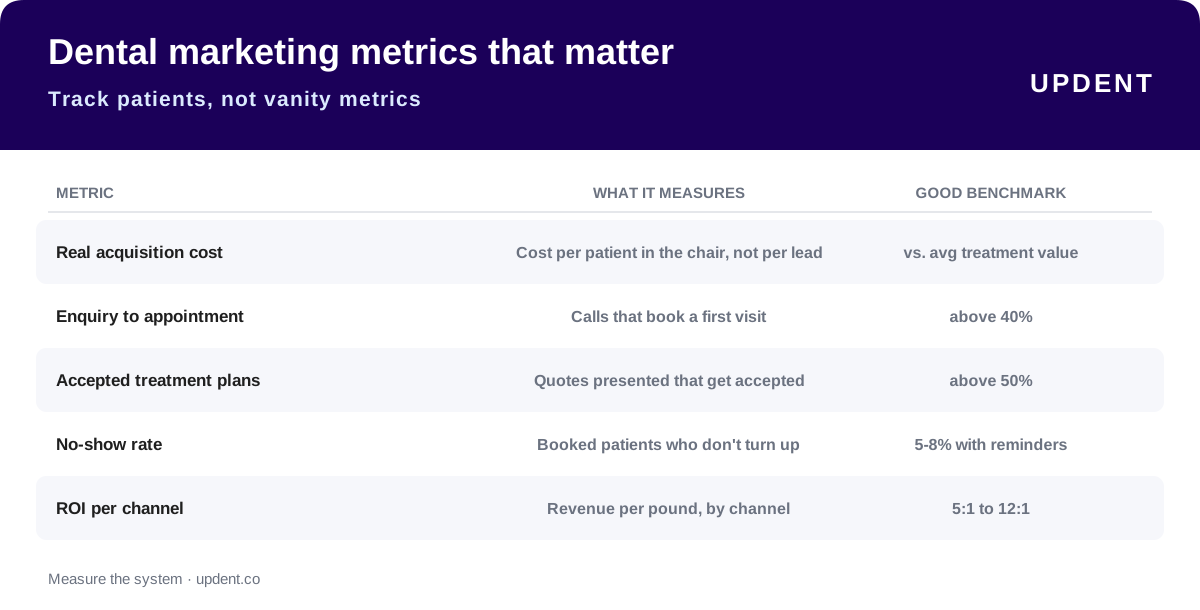
Real patient acquisition cost. Not the cost per lead. The cost per patient who sits in the chair. If you pay £40 per lead but only 20% reach the first appointment, your real acquisition cost is £200. This figure is the one that has to be compared with the average treatment value to know whether your marketing is profitable.
Call/enquiry to appointment conversion rate. The percentage of enquiries that end up booking a first appointment. If it is below 40%, the problem is not in the ads: it is in reception, the response time or the follow-up protocol.
Accepted treatment plans. Of every 10 quotes presented, how many are accepted? If the rate is below 50%, there is work to do on quote presentation, financing options or subsequent follow-up.
ROI per channel. How much revenue each pound invested in each channel generates. Google Ads, SEO, Meta Ads, email: each one has to justify its investment with numbers, not with vanity metrics like impressions or reach.
The metrics that should not be your main objective (even though many agencies report them as success): impressions, clicks, CTR, isolated cost per lead, social media followers, post reach. They are intermediate indicators, not business results.
To measure all this you need two things: a marketing CRM independent from the clinical CRM that records the source of each patient, and a clear reception protocol that marks the result of each enquiry (appointment booked, quote presented, quote accepted).
Conclusion: dental marketing that works is a system, not a channel
Effective dental marketing in 2026 is not about choosing a channel. It is about building a system where each piece serves a function: SEO attracts organic traffic in the medium term, Ads generate immediate flow, GEO positions you in AI answers, reviews turn trust into action, email and WhatsApp retain and reactivate, the website converts visitors into appointments and reception converts appointments into real patients.
If your clinic invests in marketing but does not measure the real patient acquisition cost, has no marketing CRM and does not train its reception team, you are leaving 70% of your investment on the table.
The first step does not have to be a big investment. Request your free audit and we will tell you exactly where patients are being lost in your clinic, which channels make sense for your situation and what results you can expect. No obligation. No sales pitch.
Frequently asked questions about dental marketing
Frequently Asked Questions
A clinic with 1-2 dentists can start with £700-1,300 per month, putting half into Google Ads to generate immediate flow and the rest into SEO and online reputation. The exact figure depends on the competition in your city and the treatments you want to promote. What matters is not how much you spend, but that you measure the real acquisition cost of each patient.

José Ramón Díaz
+10 años de experiencia en Marketing y Startups especializado en el sector Salud y Dental. Ex-DR SMILE e Impress.
Want us to implement
this in your practice?
Book your free audit and we'll show you exactly how to grow.
Talk to a Strategist